

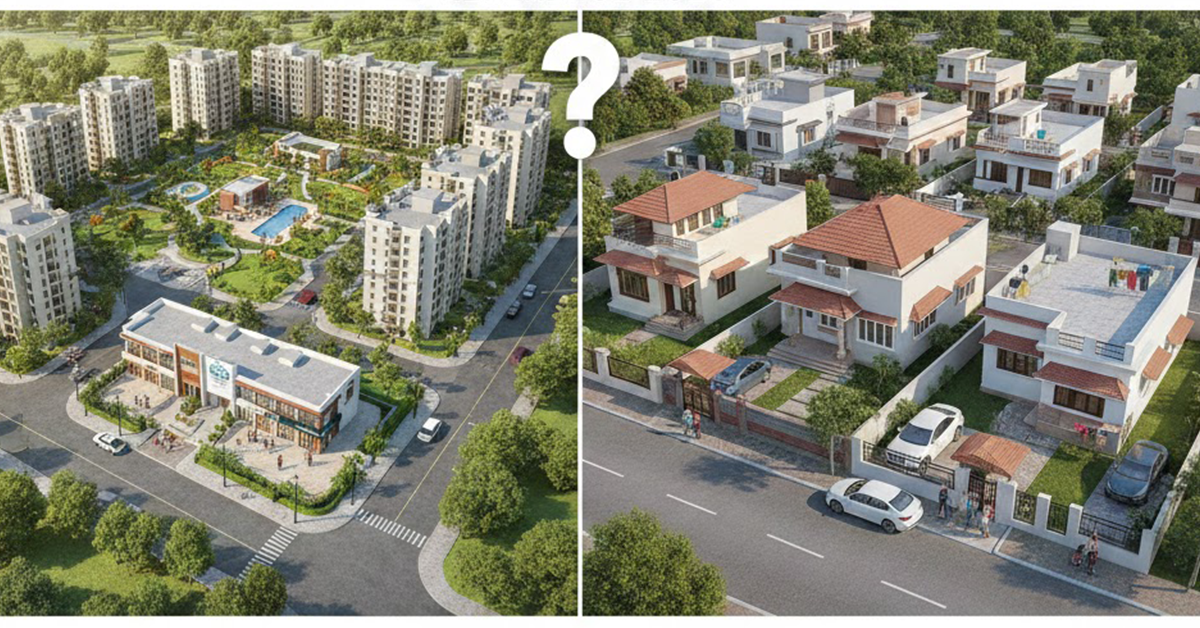
Township vs. Standalone Housing: What Indian Buyers Prefer in 2025
Buying a home in India in 2025 is no longer just about square feet and location. Post-pandemic lifestyle shifts, rising safety and amenity expectations, and a maturing market have made “where your home sits” almost as important as “what your home is.” Two choices keep coming up in buyer conversations: planned, integrated townships (gated communities, mixed-use projects) and standalone housing (independent houses, single apartment buildings or small projects). Here’s a clear, practical look at what buyers prefer — and why — so you can decide what suits your goals.
1) Why townships are gaining share (the lifestyle + convenience case)
Townships promise a self-contained lifestyle: landscaped open spaces, schools, clinics, shopping, gyms, playgrounds and controlled security inside a single master-planned area. In 2025, developers and brokers report growing demand for these projects because they deliver predictable infrastructure and a curated lifestyle — especially attractive to young families, dual-income households, and buyers relocating to Tier-2 cities who want one-stop convenience. Several industry write-ups and market reports this year note a clear tilt toward planned townships across many Indian cities. tridentrealty.co.in+1
Practical upside: time saved (less commuting for daily needs), stronger peer communities, and professional facility management (cleaning, gardening, security) — all reasons many buyers are willing to pay a modest premium.
2) Standalone housing: the emotional ownership & customization pull
Standalone homes — independent houses or small apartment blocks — still score high on emotional ownership. Buyers who prize privacy, the ability to modify or expand, and a street-level address (villa/house feel) typically go standalone. For investors seeking niche luxury or heritage-style properties, standalone options can outperform when location or unique architecture is the differentiator.
Downside: responsibility for maintenance, security and infrastructure often falls back on the owner or an ad-hoc association, which can mean time and expense — something younger, time-pressed buyers prefer to avoid.
3) Resale & investment: which holds value better in 2025?
Resale dynamics have become more nuanced. Townships with good location and services tend to have strong rental demand and faster resale velocity, as tenants and buyers increasingly prefer ready amenities and security. Several market articles in 2025 point to townships commanding a premium and showing robust appetite from both end-users and investors. Magicbricks+1
That said, standalone properties in prime micro-locations (heritage pockets, older upscale neighbourhoods, or tightly held luxury lanes) can still fetch outsized appreciation — particularly in markets where land scarcity matters.
4) Price, affordability and segment differences
Townships often command a premium for bundled amenities and professional maintenance. But in many Tier-2 and Tier-3 cities, developers are packaging affordable housing within integrated developments, making township benefits accessible across price bands. Meanwhile, luxury standalone villas in Mumbai, Bengaluru or Delhi-NCR continue to show strong price growth in the premium segment. Recent data for 2025 shows sharper price rises at the top end of the market, underlining that both product types can win — depending on the budget and city. The Times of India+1
5) What different buyer profiles prefer (quick guide)
- Young professionals & nuclear families: Township — for amenities, safety and lower chores.
- Large families/people who want space & privacy: Standalone — for customised homes and independent plots.
- Investors seeking rental yield / easy tenancy: Township — higher tenant demand and predictable maintenance.
- Buyers focused on long-term capital appreciation in prime addresses: Standalone (micro-location dependent).
These are general patterns — always map them to local supply, micro-location and future infrastructure plans.
6) Practical checklist: how to choose (apply this to any city)
- Daily convenience — Are schools, clinics, grocery and public transport within easy reach? (Townships score high.)
- Maintenance tolerance — Are you okay paying for/outsourcing upkeep, or do you prefer control?
- Security needs — Does your family need gated access and 24×7 surveillance?
- Resale strategy — Are you buying to live or to rent/sell? Townships often make renting simpler.
- Regulatory & builder track record — Check approvals, RERA registration, and post-sale maintenance clauses (some state bylaws now require longer maintenance obligations for developers). The Times of India
- Micro-location — Even a great township in a poor connectivity pocket will underperform; similarly, an independent house in a well-connected core can outperform.
7) A few cautionary notes
- Don’t buy the brochure — visit at different times of day to judge traffic, noise and community.
- Read maintenance terms carefully: who sets the maintenance charges and how are common facilities funded? Recent regulatory moves are tightening developer responsibilities, but variations exist by state. The Times of India
- Beware “amenity wash”: not all heavy-amenity projects deliver quality upkeep — reputation and independent reviews matter.
Bottom line — what do Indian buyers prefer in 2025?
There is no single winner. In 2025 the momentum favors planned townships and gated communities for their convenience, safety and rental appeal — especially among young families and investors targeting tenants. At the same time, standalone homes retain a powerful emotional and investment niche in prime locations and among buyers who want control and privacy. Your best choice depends on the city, budget, life stage and whether you prioritise lifestyle convenience (township) or standalone ownership and customisation (independent home).